Golden Fang schooner
Inherent ViceThe Golden Fang schooner is more than a vessel: its changing names and roles make it a recurring point where maritime trade, covert finance, and Doc Sportello’s uncertain visions converge. Seen first in an uncanny encounter as a ship carrying Shasta Fay Hepworth, it later appears in an insurance policy, a photograph linked to Nixon-head counterfeit currency, and an account of cargoes considered valuable in the Third World. Each appearance sharpens the suspicion that the schooner is part of a far-reaching enterprise, while leaving the fate of Shasta and the ship’s full purpose unresolved.
Identity and changing names
Doc initially recognizes the schooner in his vision as the Golden Fang. His guide, Kamukea, silently corrects him: it is the Preserved. The correction complicates the ship’s identity rather than settling it. The vessel has the ordinary, tangible details of a working craft—sails, rigging, and timbers—yet the vision presents it within Lemuria’s sinking city, where Doc is being guided out of danger. The ship belongs to the same unstable territory as the vision: it is specific enough to be recognized, but its name and significance shift beneath that recognition.
The name Golden Fang also circulates beyond the vessel itself. Doc thinks of it as a schooner that smuggles goods, a shadowy holding company, and a Southeast Asian heroin cartel. These are not simply interchangeable descriptions of a boat; they suggest a network of activities and institutions gathered under one name. The schooner gives that diffuse organization a physical form, but the evidence does not establish that every enterprise called the Golden Fang is directly operated from the vessel.
The vision and Shasta’s passage
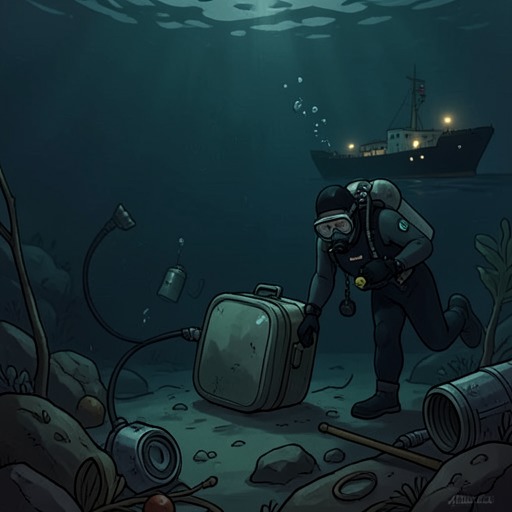
In Doc’s vision, he and Kamukea fly close to the Pacific’s waves and approach the schooner under dark weather. Doc recognizes it as the Golden Fang, while Kamukea identifies it as the Preserved. Shasta is alone on deck, looking back toward the home she has left. Doc tries to call to her, but the vision makes clear that speech cannot reach her there. Kamukea assures him that Shasta will be all right and frames the experience as something Doc must learn from, not merely a warning that he can act upon.
That reassurance does not erase Doc’s unease. He senses that the vessel has been inhabited by an ancient, malign force, and doubts that Shasta can be safe aboard it. The scene holds its competing registers together: the ship’s working rigging and canvas are described as real within the experience, while the encounter arrives through a vision connected to the submerged Lemurian city. The result is not a confirmed account of what happened to Shasta, but an image of separation and uncertain protection that anticipates the later, more material clues about the schooner.
Shasta later tells Doc that, while he was on an acid trip supplied by Vehi Fairfield, he saw her on the same boat and tried to reach it from the wind. She says she felt haunted and had wondered whether the presence was Doc; he confirms that it may have been. Her recollection connects the two experiences without explaining them away. It also supplies a practical detail about her passage: the ship’s chief cook, Porfirio, told her that everyone aboard—officers, crew, and passengers—was armed. When Shasta asked whether she could borrow a weapon from the armory, he said that she was a passenger and that the crew would protect her. He explained that their cargoes were highly desirable, particularly in the Third World, and called the threat pirates. The exchange implies valuable cargo and onboard security, though it does not identify the goods or prove who posed the danger.
Insurance and the possibility of a planned loss
Sauncho Smilax tells Doc that an ocean marine insurance policy was taken out on the Golden Fang shortly before it singled up all lines. The policy covered only one voyage—the voyage Shasta was supposed to be on—and named Golden Fang Enterprises of Beverly Hills as beneficiary. When Doc asks whether the company would collect a large payment if the vessel sank, Sauncho confirms that it would. The timing, restricted coverage, and named beneficiary give Doc concrete grounds to suspect a deliberate insurance fraud, but the policy alone does not prove that the ship was sunk, that the voyage was staged, or that Shasta’s life was part of a scheme.
Doc’s response to this possibility becomes a series of imagined alternatives rather than a resolution. He wonders whether Shasta might have reached an island and found safety there, while the Golden Fang continued toward its own fate with those who had not escaped. These possibilities show how the vessel’s suspected financial purpose intensifies the uncertainty around its passenger: the ship may be a mechanism for profit, but Doc cannot know whether Shasta has escaped its consequences. His hope that she is safe remains explicitly conjectural.
The counterfeit-bill photograph
A later investigation brings the schooner into contact with the Nixon-head counterfeit bills Doc has already encountered. In a folder of arrest records, he finds a photograph of Adrian Prussia standing on a pier beside an open box about the size of a coffin, filled with U.S. currency. Prussia is holding up a twenty-dollar bill. Recognizing the bill as the CIA Nixonhead funnymoney, like the bills recovered from the water by Sauncho and his companions, Doc examines the photograph more closely. In the background, slightly out of focus, lies the Golden Fang schooner. The photograph is dated less than a year earlier.
The image supplies a concrete link among Prussia, a large quantity of counterfeit money, and the vessel. It does not reveal what happened to the currency after the photograph was taken, or whether the bills in the box were the same batch later recovered from the water. Doc therefore asks Sauncho whether anyone kept a record of the Nixon bills after they were hauled in. Sauncho says that he would like to think most were safe in a federal evidence room; Doc’s question leaves that reassuring assumption in doubt. The schooner’s appearance in the photograph turns it from a suspected smuggling ship into part of a wider chain of unanswered questions about money, evidence, and the people able to move between them.
A vessel between evidence and uncertainty
The schooner’s significance comes from the way it recurs across different kinds of knowledge. It appears in a vision of Shasta aboard a ship called the Preserved, in Shasta’s own account of sensing Doc nearby, in the insurance arrangement tied to a single voyage, and in a dated photograph connecting it to Prussia and counterfeit currency. Separately, Shasta’s account of the armed passengers and valuable cargo provides a plausible maritime-security context for the vessel. None of these clues alone discloses the whole operation, and their accumulation invites suspicion without closing the case.
The ship thus gives physical shape to the Golden Fang’s reach while preserving the novel’s uncertainty about what that reach means. It can be read as a vessel carrying risky cargo and exposed to financial manipulation; it is also the object through which Doc’s concern for Shasta enters a supernatural vision. The name Preserved, set against the possibility of a planned sinking and the image of a ship moving onward without those who might reach shore, carries an unresolved tension between survival and loss. The evidence establishes the schooner’s importance and its associations, but not a definitive account of its ultimate fate or Shasta’s safety.